What happened
The bump, blow, or jolt — and what was observed immediately afterward.
Most concussions never show on a CT or MRI. That gap — between a real injury and a quiet scan — is where claims get lost. This desk explains concussion mechanics, symptom documentation, and how the evidence file should be built. No invented numbers, no advice dressed as information.
Symptoms after a head injury can be a medical emergency — call 911 for loss of consciousness, repeated vomiting, or worsening headache. This site does not give medical or legal advice.
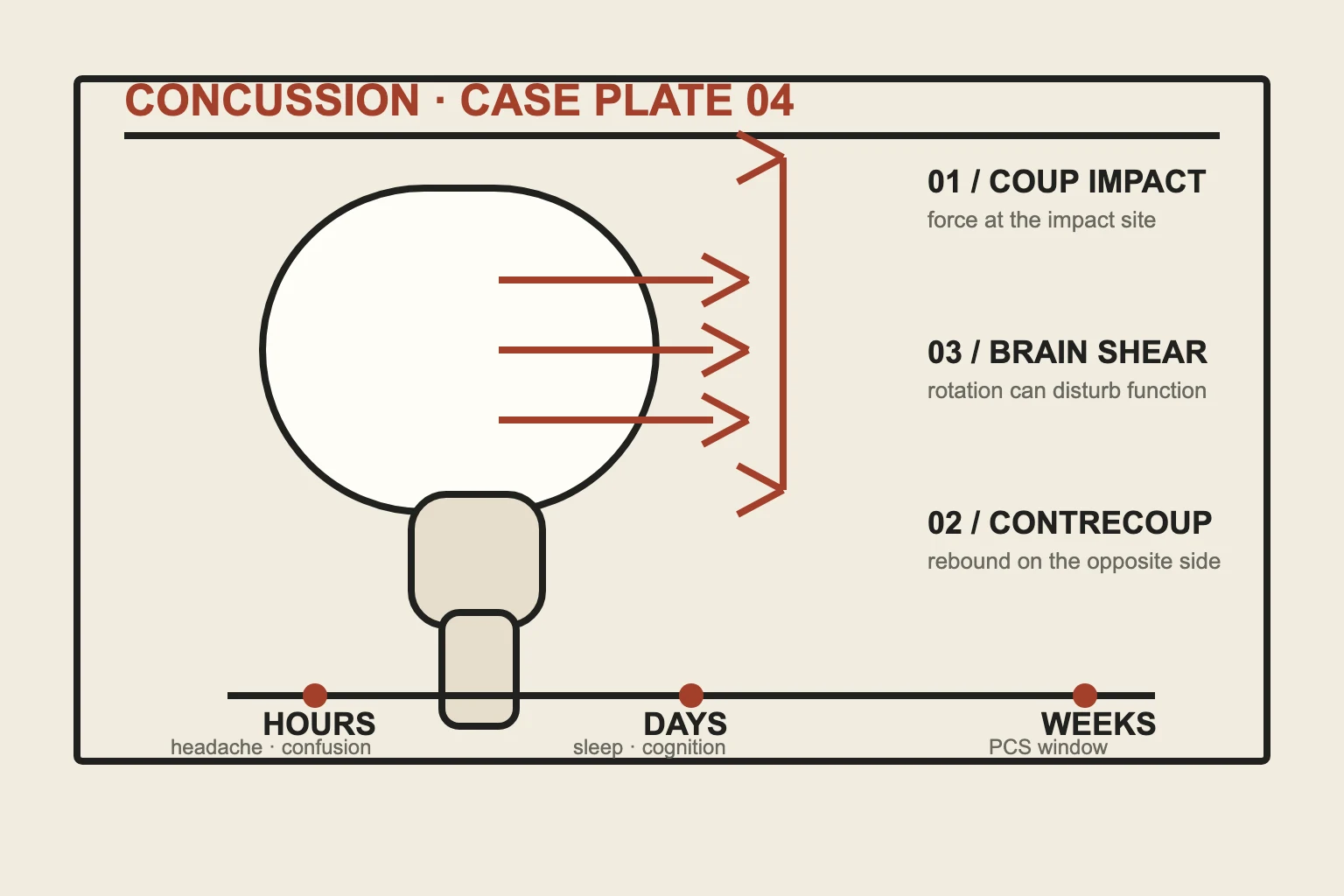
Force at the impact site.
02 / CONTRECOUPRebound on the opposite side.
03 / BRAIN SHEARSymptoms can persist beyond a clear scan.
Concussion education cannot replace urgent medical evaluation. Seek emergency help for danger signs after a head injury.
Repeated vomiting, a worsening headache, seizure, slurred speech, unusual confusion, or increasing drowsiness warrant emergency attention.
Note the time, activity, symptom, intensity, and what made it better or worse. A contemporaneous record preserves sequence.
This desk explains public sources. A qualified clinician evaluates an injury; a qualified lawyer evaluates a legal claim.
Routine imaging may be normal because concussion can affect function without a visible structural finding.Concussion Claim Desk — FAQ, grounded in CDC materials
The strongest symptom record is specific, dated, and connected to function. A claim record is easier to evaluate when it separates event facts, medical evidence, functional change, and the timeline connecting them. The documentation gap is where real injuries get lost.
Build the symptom file →The bump, blow, or jolt — and what was observed immediately afterward.
Evaluations, diagnoses, imaging reports, referrals, restrictions.
Date, time, the person's own words, and what changed.
School, work, driving, sleep, exercise, ordinary tasks.
Event, clinical, function — one timeline connecting them.
California deadlines can be fact-specific; this desk does not calculate a filing deadline or give legal advice. The claims file explains the evidence structure instead.
Read the claims file →Every file distinguishes medical information from California legal and statutory guidance. The desk grounds itself in CDC materials, the California Education Code (leginfo), PubMed literature, and the ICD-10-CM coding reference — so readers can move from a plain-language explanation to the underlying authority.